There are many stereotypes on the North and South of England and also the views that the people from the areas have on each other. Over the course of the scene stereotypes are mainly matched but on the odd occasion are reversed. The south was a richer area and still is than the north and it was strange for a family to move from the south to north. This scene explores the views of different character types and how they react to certain situations. The mise en scene is an accurate account on how it was such as dirty rag clothing and dark dirty alleyways for the north and nice clothing and luxury homes for the south.
The scene starts with a couple arguing that the audience immediately identifies as being husband and wife. The wife seems to be upset that they have moved from where they were. The title North and South makes it clear to the audience that it is about the difference between life in the North and life in the South. The man is very apologetic and says 'I had no choice' The camera angles used show the man looking down on the woman and the woman looking up on the man because in that time period men were more superior than women. This keeps with the mise en scene and the time period well. The woman steps back into the darkness to signify her end to the argument and emphasises the possible darkness that living in the area may lead them to. The audience sees that this family are quite rich and live in luxury with good quality paintings all around the house.
The scene in the luxury house then moves onto dark alleyways amongst the working class in dirty rags this juxtaposes with the luxury house and emphasises the difference between classes. The woman that is walking down the alleyways is the daughter of the couple in the first scene. The audience knows this because of the slight glance they had of her in the first scene in the house. As she walks non-digetic sound of her reading a letter is read. The voice over is a good way of giving the audience an understanding of what is going on in the scene and also a bit of background information. It also tells you that she is educated that she can read and write and enforces the idea of the 'rich south' The letter reads that she could get used to life 'up North' and 'the people seem nice'. Just as that is read a big flock of men on their break come rushing down the stairs that she is on. She is pushed and assaulted and seems very shocked. The men all grab at her to try and steal from her and clips of action are missed out in this to make the scene more frantic for the audience. During this there are quick shots of the men's legs at a low angle which makes it seem like a stampede and the woman small and venerable. This enforces the stereotype of the North of how they are rowdy, poor and will do anything for money such as stealing. The stereotype is then reversed when a man pushes the others away and gives her back her money. She is very grateful to the man for protecting her and offers him a tip for his services. To her and the audiences surprise he refuses the tip which reverses the stereotype of the people from the north tyring to get money in any way. The scene ends on a high angle open shot when she is free from the stampede which connotes freedom again and her relief.
Overall this extract is split up well into North and South. where it starts with the rich side the southerners life and then moves onto the rough and poor north area. It's ironic that although the south are the richer but are most upset and the north seem happy with life and get on with it.
Sunday, 19 April 2009

Friday, 17 April 2009
How has new technology influenced production, marketing and exhibition in the film industries in the last 30 years?
How has new technology influenced production, marketing and exhibition in the film industries in the last 30 years?
New Technology has become increasingly better in the past 30 years and has a huge influence on the way films are produced marketed and exhibited. New techniques and increased computer technology has driven the film industry foreword but it does have its drawbacks.
The production of films have been able to be more impressive due to great effects that can be used with great ease. This allows the producer and director to be more ambitious with their films. For example Star Wars and Lord of the Rings, there recent films have huge impressive fight scenes with huge high action. The proof is in the 1st films and the last. Star Wars first was first around in the late 70s and for the times had great special effects which one many awards such as best visual effects and best special effects. George Lucas produced another trilogy starting with ‘The Phantom Menace) in 1999 which had much improved visual qualities. However this biggest improvement came from Lord of the Rings which was directed by Peter Jackson. The first film (The Fellowship of the Ring) came out in 2001 and within 2 years to the third (The Return Of the King) dramatic improvements were made. This shows the greater improvement of technology recently in a smaller period than in the 20 year period before in star wars.
The development of techniques such as ‘green screens’ has been increased and is being used very effectively in films. Using green screens allows you to mix to images or frames together while erasing a background colour. This has been used effectively in films such as Indiana Jones. They had a big boulder rolling after a character and to avoid making the actor run from a boulder they used a green screen. It is also used to create locations, the TV series Doctor Who features the characters going to all different places so instead of using up money the locations can not only be shown up with the characters on but can be edited in any way wanted. For example having a location set in Victorian times which you wouldn’t be able to do if you went over to the place and filmed.
Marketing of films has become easier with the increase of technology because of the different ways to advertise a film. The Internet is now one of the best ways to market a film. Trailers can be put out all over the Internet on sites such as Youtube. Reviews on websites which could advertise a film depending on the review, however could have a negative effect on the film. The Dark Knight created its own websites with forums which built up the film and created a massive hype for the film.
‘Itunes’ is also another new way of marketing a film. Films are sold through ‘Itunes’ which is a programme made by the American company Apple which allows people do download podcasts, music, TV series and films. Distributors sell the film to Apple who then sells them onto the customers which renovates money to film. 10 years ago all of this wasn’t around without the Internet you get none of it. However, film piracy is a huge problem for the film industry and the Internet is the main problem many websites feature illegal copies of films which can be watched by anyone with the internet. There has been ways of trying to stop this or at least reduce it but it seems to be to big to control.
Exhibition in the film industry has become also better because of the new ways of producing a film. 30 years ago films came out onto VCR in a cardboard case but now there are allsorts of variety. DVD is the most common format of a film you will see which can be played on games consoles as well as DVD players. There is also the new Blu-ray, which allows the viewer to see the film in a much higher quality or definition (HD). These new formats are also a lot more reliable compared with VCR. Not only have these new formats been made available and more reliable but also the majority of films now come with bonus disc. This may include things like Outtakes, ‘the making of the . . .’ or deleted scenes. So you no longer just watch the film which adds to the entertainment. Also the increase in technology helps create a better DVD cover a more eye catching and effective picture compared to the older less exciting pictures found on videos. As marketing has a problem via the internet exhibition also have small similar problems such as fake illegal copies of a DVD which can be made with the right software.
New Technology has become increasingly better in the past 30 years and has a huge influence on the way films are produced marketed and exhibited. New techniques and increased computer technology has driven the film industry foreword but it does have its drawbacks.
The production of films have been able to be more impressive due to great effects that can be used with great ease. This allows the producer and director to be more ambitious with their films. For example Star Wars and Lord of the Rings, there recent films have huge impressive fight scenes with huge high action. The proof is in the 1st films and the last. Star Wars first was first around in the late 70s and for the times had great special effects which one many awards such as best visual effects and best special effects. George Lucas produced another trilogy starting with ‘The Phantom Menace) in 1999 which had much improved visual qualities. However this biggest improvement came from Lord of the Rings which was directed by Peter Jackson. The first film (The Fellowship of the Ring) came out in 2001 and within 2 years to the third (The Return Of the King) dramatic improvements were made. This shows the greater improvement of technology recently in a smaller period than in the 20 year period before in star wars.
The development of techniques such as ‘green screens’ has been increased and is being used very effectively in films. Using green screens allows you to mix to images or frames together while erasing a background colour. This has been used effectively in films such as Indiana Jones. They had a big boulder rolling after a character and to avoid making the actor run from a boulder they used a green screen. It is also used to create locations, the TV series Doctor Who features the characters going to all different places so instead of using up money the locations can not only be shown up with the characters on but can be edited in any way wanted. For example having a location set in Victorian times which you wouldn’t be able to do if you went over to the place and filmed.
Marketing of films has become easier with the increase of technology because of the different ways to advertise a film. The Internet is now one of the best ways to market a film. Trailers can be put out all over the Internet on sites such as Youtube. Reviews on websites which could advertise a film depending on the review, however could have a negative effect on the film. The Dark Knight created its own websites with forums which built up the film and created a massive hype for the film.
‘Itunes’ is also another new way of marketing a film. Films are sold through ‘Itunes’ which is a programme made by the American company Apple which allows people do download podcasts, music, TV series and films. Distributors sell the film to Apple who then sells them onto the customers which renovates money to film. 10 years ago all of this wasn’t around without the Internet you get none of it. However, film piracy is a huge problem for the film industry and the Internet is the main problem many websites feature illegal copies of films which can be watched by anyone with the internet. There has been ways of trying to stop this or at least reduce it but it seems to be to big to control.
Exhibition in the film industry has become also better because of the new ways of producing a film. 30 years ago films came out onto VCR in a cardboard case but now there are allsorts of variety. DVD is the most common format of a film you will see which can be played on games consoles as well as DVD players. There is also the new Blu-ray, which allows the viewer to see the film in a much higher quality or definition (HD). These new formats are also a lot more reliable compared with VCR. Not only have these new formats been made available and more reliable but also the majority of films now come with bonus disc. This may include things like Outtakes, ‘the making of the . . .’ or deleted scenes. So you no longer just watch the film which adds to the entertainment. Also the increase in technology helps create a better DVD cover a more eye catching and effective picture compared to the older less exciting pictures found on videos. As marketing has a problem via the internet exhibition also have small similar problems such as fake illegal copies of a DVD which can be made with the right software.
Friday, 3 April 2009
How does Bleak House create tension ?
How does Bleak house create tension?
The TV series Bleak house uses a variety of different techniques to create tension. Camera angles and editing techniques can make the audience feel a certain way.
In a scene I watched I found they used a lot of clever camera angles to make the audience feel like they shouldn’t be there. Filming lots of depth of field shots with always something in the foreground makes the audience feel as if they are ‘hiding’ and ‘spying’ on a conversation. For example the shots of the corner of a table which gets in the way of the shot. This way you can never see the whole image of his face which adds to mystery and tension.
It is also used to show a characters feeling and reaction. For example there is a shot which is used at the start to show other characters entry into the room. At the same time in the foreground of the shot is the woman. This way the audience can then see the expression on her face as they walk in. The audience can immediately judge her feelings towards these characters. The same shot is used to involve the character in the conversation and the audience are aware she is listening in.
Dramatic sounds are used in the editing process to add drama to the scene. Computer generated sounds are played in loud to frighten an audience and this adds tension. For example when the character notices a name on the letter the quick camera shots of her face and the letter with the added sound create a scary effect. There are also added sounds leading up to the woman collapsing. First there is a heartbeat which builds up the scene and the audience know something is going to happen. Then just before she falls the sound is muffled and effects are put on the audio again adding to the tension. When the woman eventually collapses there is a sound of her head hitting the ground makes more realistic and to make the audience feel the action more.
Other editing effects such as slow motion can emphasise the feeling of a character. For example towards the end of the scene a slow motion effect is put on the character that is displayed as being bad or evil. This allows the audience to capture his evil look thus create more tension.
There is also an added tint to the shots featuring this character to make the audience more aware of who is good and who is bad. There is then added tension immediately when the audience see the tinted effect.
Clever use of composition at the beginning of the scene adds to the darkness of the bad character. It makes sure that there is a dark shadow covering most of his face, again adding to the idea of never getting a clear image of this character. This creates a scary image of the character and immediately represents his evilness, adding to the tension.
In the next scene it immediately begins with quick shots and loud noises which scares the audience and creates tension. A character shouts at another telling him ‘You’ll be out on the streets’ which makes the audience feel for the character who seems scared. It shows him then in his room where he counts money clips are missed out which speeds up the piece and misses out action. This creates a frantic atmosphere and adds tension.
The TV series Bleak house uses a variety of different techniques to create tension. Camera angles and editing techniques can make the audience feel a certain way.
In a scene I watched I found they used a lot of clever camera angles to make the audience feel like they shouldn’t be there. Filming lots of depth of field shots with always something in the foreground makes the audience feel as if they are ‘hiding’ and ‘spying’ on a conversation. For example the shots of the corner of a table which gets in the way of the shot. This way you can never see the whole image of his face which adds to mystery and tension.
It is also used to show a characters feeling and reaction. For example there is a shot which is used at the start to show other characters entry into the room. At the same time in the foreground of the shot is the woman. This way the audience can then see the expression on her face as they walk in. The audience can immediately judge her feelings towards these characters. The same shot is used to involve the character in the conversation and the audience are aware she is listening in.
Dramatic sounds are used in the editing process to add drama to the scene. Computer generated sounds are played in loud to frighten an audience and this adds tension. For example when the character notices a name on the letter the quick camera shots of her face and the letter with the added sound create a scary effect. There are also added sounds leading up to the woman collapsing. First there is a heartbeat which builds up the scene and the audience know something is going to happen. Then just before she falls the sound is muffled and effects are put on the audio again adding to the tension. When the woman eventually collapses there is a sound of her head hitting the ground makes more realistic and to make the audience feel the action more.
Other editing effects such as slow motion can emphasise the feeling of a character. For example towards the end of the scene a slow motion effect is put on the character that is displayed as being bad or evil. This allows the audience to capture his evil look thus create more tension.
There is also an added tint to the shots featuring this character to make the audience more aware of who is good and who is bad. There is then added tension immediately when the audience see the tinted effect.
Clever use of composition at the beginning of the scene adds to the darkness of the bad character. It makes sure that there is a dark shadow covering most of his face, again adding to the idea of never getting a clear image of this character. This creates a scary image of the character and immediately represents his evilness, adding to the tension.
In the next scene it immediately begins with quick shots and loud noises which scares the audience and creates tension. A character shouts at another telling him ‘You’ll be out on the streets’ which makes the audience feel for the character who seems scared. It shows him then in his room where he counts money clips are missed out which speeds up the piece and misses out action. This creates a frantic atmosphere and adds tension.
Sunday, 29 March 2009


Tuesday, 10 March 2009
What is the balance of realism and drama in particular soaps ?
All 'soaps' have to maintain a high level of realism and drama throughout their shows. The main focus points for the creators is to keep a good balance between the two points. There needs to be a high level of drama happening throughout an episode to keep the audience hooked and to make it interesting. However they need to balance this with the realism. Realism is the way of keeping it as realistic as possible so that audiences can relate to it. Having to much Drama and not enough realism makes a show become unreal and rejects the conventions of a 'soap'
A popular show like Eastenders always keeps a high level of drama and has sometimes over the past been criticised because of its unrealistic approach to modern day live. This includes the 'shooting of Phil' and 'Max being buried alive'. Eastenders tries to keep high action such as the Shooting of Phil after the drama attracted over 19 million viewers and became the biggest soap success. However when Max was buried alive there was a huge negative impact and Eastenders had to apologise to its viewers after many complaints. Eastenders takes place at 8.30pm which is before the 'watershed' and having a character 'drugged and buried alive' was found not suitable by many viewers.
Overall, successful soaps find a good balance and occasionally throw in a high drama event to attract many viewers which can cause a positive or negative effect as proved by Eastenders.
A popular show like Eastenders always keeps a high level of drama and has sometimes over the past been criticised because of its unrealistic approach to modern day live. This includes the 'shooting of Phil' and 'Max being buried alive'. Eastenders tries to keep high action such as the Shooting of Phil after the drama attracted over 19 million viewers and became the biggest soap success. However when Max was buried alive there was a huge negative impact and Eastenders had to apologise to its viewers after many complaints. Eastenders takes place at 8.30pm which is before the 'watershed' and having a character 'drugged and buried alive' was found not suitable by many viewers.
Overall, successful soaps find a good balance and occasionally throw in a high drama event to attract many viewers which can cause a positive or negative effect as proved by Eastenders.
Monday, 2 March 2009
Representation of youths in Skins
The Tv drama Skins is aimed at an audience of the similar age to the characters. Therefore the representation of youths isn't negative or over blown but realistic. For example when Tony is on the phone to friends he swears on regular occasions, ' Yours are fucking funny'. However when he speaks to Sid's Dad he is polite. This shows the respect that is shown towards adults. This is generally a strong representation of today's youths. Sid's Dad however is shown as a bad example by swearing at Sid straight after. This shows that some of the characters are possibly influenced by bad parenting. The start of the scene shows Tony playing his music very loud in the morning which angers his Dad. He also swears a lot such as 'Every fucking morning' and the language and anger represents the stress of having a teenager.
Tony is shown walking and talking on his mobile. which shows he has no time to sit and chat, this shows the fast pace of life that teenagers lead. Panning and tracking shots also add to the pace by following him wherever he goes.
Tony is shown walking and talking on his mobile. which shows he has no time to sit and chat, this shows the fast pace of life that teenagers lead. Panning and tracking shots also add to the pace by following him wherever he goes.
Wednesday, 25 February 2009


Tuesday, 24 February 2009
My Opinions
Changes from original plan
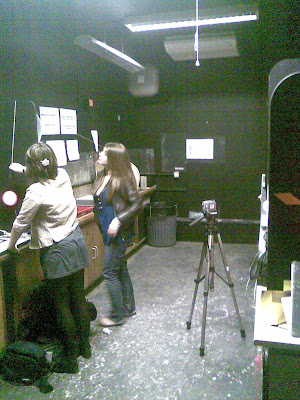
After practice shots in the dark room we figured we definitely needed extra lighting. We brought in a desk side lamp to increase the brightness. We found that we were not getting that same red effect with the white light so we used red paper over the front of the light. This worked really well and kept the same effect that we wanted.
Our storyline did change a little bit as we didn't focus on the character appearing in each photo as we found it hard to film. It was hard to get good quality close ups of the photos, especially due to the lack of light. I think this may have affected the understanding of the thriller more but it however then creates more mystery to the film.The casting also changed after the disaster of a group member leaving the school. We were originally going to use her sister's boyfriend.We added in extra scenes which were ideas thought of during the filming. For example we used a picture of the girl on the man's mobile phone which made the storyline more clear. We also added in a clip of the man disappearing behind a van which has a great reference to 'The Third Man'.We originally were struggling for names and we were going to call it 'DarkRoom' but after selecting 'Requiem' as the soundtrack, we decided on calling it 'Requiem' as the word is meant as a memorial of a death. This predicts the future and you know a death is going to happen. This adds to the tension of the opening.
Negative Points
Certain bits of the filming didn't quite work out when we came to view them on the computer. For example, the image on the mobile isn't as clear as we would have liked which could mislead the audience.
When the shadow is cast over the back of the girl, the recording was cut a little too short. This could have made better by keeping the shadow of the hand for a few more seconds.
The lighting in the dark room could have been better in places.
Positive Points
The filming was steady and there was a good selection of shots.
The music fits really well with the film creating tension.
It fits well to the codes and conventions of the thriller genre.
After practice shots in the dark room we figured we definitely needed extra lighting. We brought in a desk side lamp to increase the brightness. We found that we were not getting that same red effect with the white light so we used red paper over the front of the light. This worked really well and kept the same effect that we wanted.
Our storyline did change a little bit as we didn't focus on the character appearing in each photo as we found it hard to film. It was hard to get good quality close ups of the photos, especially due to the lack of light. I think this may have affected the understanding of the thriller more but it however then creates more mystery to the film.The casting also changed after the disaster of a group member leaving the school. We were originally going to use her sister's boyfriend.We added in extra scenes which were ideas thought of during the filming. For example we used a picture of the girl on the man's mobile phone which made the storyline more clear. We also added in a clip of the man disappearing behind a van which has a great reference to 'The Third Man'.We originally were struggling for names and we were going to call it 'DarkRoom' but after selecting 'Requiem' as the soundtrack, we decided on calling it 'Requiem' as the word is meant as a memorial of a death. This predicts the future and you know a death is going to happen. This adds to the tension of the opening.
Negative Points
Certain bits of the filming didn't quite work out when we came to view them on the computer. For example, the image on the mobile isn't as clear as we would have liked which could mislead the audience.
When the shadow is cast over the back of the girl, the recording was cut a little too short. This could have made better by keeping the shadow of the hand for a few more seconds.
The lighting in the dark room could have been better in places.
Positive Points
The filming was steady and there was a good selection of shots.
The music fits really well with the film creating tension.
It fits well to the codes and conventions of the thriller genre.
Monday, 23 February 2009
Sunday, 22 February 2009
Evaluation of Thriller
Evaluation: Unit G321 Jacob Mardell 12.2.2
In what ways does the media product use , develop or challenge forms and conventions of real media products?
Our media project uses the forms and conventions of real media products well. Setting the film in a darkroom created a generically claustrophobic and dark atmosphere. This together with the soundtrack, creates tension and the piece builds up the film well. We also filmed at Elm Hill and used a huge variety of different angles such as high and low angle shots, over the shoulder and close ups. We made reference to 'The Third Man' by using low angle, canted shots. The costumes used reflect the codes and conventions of the thriller genre. For example, the innocent clothing of the victim makes her seem vulnerable in comparison to the dark clothing of her pursuer. The dark clothes represent 'the dark side' and makes the audience aware immediately. The girl's vulnerability is made greater by the fact she is in the dark room with one small exit. We knew we wanted a classical piece in our thriller and we wanted it to build up the film. Searching through classical compilations we came across 'Requiem'. The piece built up slowly fitting well with a film. It has a meaning because the word requiem means 'a song composed in memorial of a dead person, this could anticipate the audience. After researching into films such as Lock, Stock and Two Smoking Barrels and The Third Man I realised they used a lot of unglamorous locations.
Overall, Our project succeeded in using the codes and conventions of a real media product such as 'The Third Man'. Our film uses generic conventions of a thriller such as unglamorous locations and claustrophobic spaces.
How does the media product represent particular social groups?
Our project features an 'innocent girl' and a 'spooky man'. The girl is immediately represented as an innocent and vulnerable girl which is added to by the spooky location. Having a female rather than a male does create more vulnerability and scares the audience more. The man is represented as an suspicious character who is possibly a serial killer.
The man is shot slowly walking up the stairs and along the street and the low angle shots represent his power and control he has over the situation. Stereotypically men are represented as the stronger sex and this can create a scarier atmosphere. If it had been done the other way round I don't think it would have created quite the same affect.
Many Thrillers use all male casts or just use males as main characters only such as ‘Lock, Stock and Two Smoking Barrels’ and ‘Layer Cake’ this is because of the drugs and violence in these crime-thrillers. This is because women are portrayed as weak and feeble. Our thriller would not be as affective using an all male cast and it could also narrow our target audience.
What kind of media institution might distribute your media product and why?
This type of film should definitely feature in the cinemas to make it much more thrilling with surround sound and a big dark room. I think our project would be shown in an arts house, such as Cinema City in Norwich. Our film has no reputation whatsoever, for directors or actors. The film 'Phone Booth' had a box office appeal because of Colin Farrell and director Joel Schumacher. This makes the product more easy to market and can immediately be released as a 'Blockbuster'. Realistically our film is a small low budget film which would be better off in smaller cinemas. It would definitely been shown on TV. It could be a classic to watch in years to come and develop a cult following. The TV showing would have to be during late evening because it would have an age rating of 15 because of the violence.
With the latest expansion of Youtube and social networking sites. Everyone all over the world can see. This way trailers can be displayed and also shared around social networking sites to add to advertisement of the film. Itunes is also another great use technology development because films can be downloaded from them and put onto people Ipods where they can watch it when and wherever they want. This renovates money to the film because the distributors will sell the film to companies like Apple to sell the film in this way.
How did you attract/address your audience ?
From research I found that mystery thrillers such as 'Phone Booth' were popular amongst the age group 16-20 years. Our film features a young cast of around this age and audiences can relate to this. We aimed the film at both genders to widen our audience. The title of our thriller is Requiem and I feel this is quite a complex title which may attract an older audience of 20-30 years. I also feel that the title of our film makes it quite sophisticated and possibly intriguing. We thought of calling it 'Leyla's Requiem' but agreed in our group that just Requiem was stronger. We also consulted our classmates to see what they preferred. Everyone said they preferred just 'Requiem' which helped us to decide.
Using a classic track which is well known across the world of classical music. Fauré: Requiem, Op. 48 - 1. Could catch people attention when watching the film. From the feedback I have had people have said the soundtrack is a great piece which goes very well with the film.
What have you learnt about technologies from the process of constructing this product?
I know quite a bit about digital cameras and how they work but I didn't know so much about tape cameras. The camera sometimes went out of focus due to changes in light or when zooming. These shots had to be taken again until they were right. I have used 'Windows Movie Maker' a lot and find it really easy to use but the editing software we used, 'Adobe Premier Elements', I had only used once before on the preliminary task but just for basic needs. However it was easy to pick up and add effects. For example, cross dissolve was a new transition effect I learnt to use effectively. As our project doesn't involve diegetic sound there is no problem with a buzzing sound of muffled speech. As we found in our preliminary task, speech on the camera isn't very clear unless you use the external microphone. Looking at films like 'Layer Cake' with an external monologue we immediately knew that a monologue wouldn't fit well to our piece. It fits very well in films like Layer Cake to help describe what is going on. In a Mystery Thriller the audience sometimes isn't clear on the story, but that is the mystery. We wanted our audience to work hard and to keep guessing.
Looking back at your preliminary task, what do you feel you have learnt in the progression from it to the full product?
Doing the preliminary task helped with our thriller project because it gave us some experience with the camera and the editing software. Especially looking specifically into the 180 rule and shot reverse shot which we did use in our project. This then gave us more time which could be spent usefully rather trying to find out how things worked. We have progressed well from the task to the full product because the ideas we have are stronger. We were stuck for a while on what to do for a very simple task. When the thriller came along I felt we wrote quite a complex storyline which is very effective. Practically, I feel it’s not a huge improvement but I am still happy, Our preliminary task was well shot with a good variety of angles and was hard to make a big improvement on. My filming has improved since I have used the camera for the thriller learning from experience. I also realised that your end product is always better with a lot of planning behind it. Planning is the key to great film making and time was wasted on ideas during the filming for the preliminary. Whereas with our thriller we knew what shots we wanted and what we wanted to shoot.
Overall, the project went very well. I learnt that planning well for each session and small details resulted in us using time more profitably. I enjoyed making the film and I know for next time small improvements such as when filming, not cutting the recordings too early because it can be edited at a later stage.
‘Requiem’
In what ways does the media product use , develop or challenge forms and conventions of real media products?

Our media project uses the forms and conventions of real media products well. Setting the film in a darkroom created a generically claustrophobic and dark atmosphere. This together with the soundtrack, creates tension and the piece builds up the film well. We also filmed at Elm Hill and used a huge variety of different angles such as high and low angle shots, over the shoulder and close ups. We made reference to 'The Third Man' by using low angle, canted shots. The costumes used reflect the codes and conventions of the thriller genre. For example, the innocent clothing of the victim makes her seem vulnerable in comparison to the dark clothing of her pursuer. The dark clothes represent 'the dark side' and makes the audience aware immediately. The girl's vulnerability is made greater by the fact she is in the dark room with one small exit. We knew we wanted a classical piece in our thriller and we wanted it to build up the film. Searching through classical compilations we came across 'Requiem'. The piece built up slowly fitting well with a film. It has a meaning because the word requiem means 'a song composed in memorial of a dead person, this could anticipate the audience. After researching into films such as Lock, Stock and Two Smoking Barrels and The Third Man I realised they used a lot of unglamorous locations.

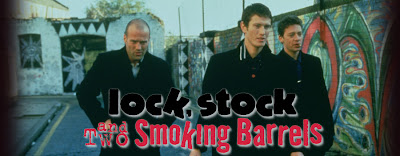
Using unglamorous locations in Lock, Stock and Two Smoking Barrels, Guy Ritchie gives the film realism which fits well with the background of violence and drugs.
The graffiti and broken brickwork shows how unglamorous and run down the area is.
We chose the names ‘Simon Moore’ for the pursuer and ‘Leyla Kismet’ for the victim. The name Simon means ‘to be heard’ which means he wants attention and wants to be known. Doing something like murder may get him known or he could also be depressed by the lack of attention so he is angry. We chose his surname to be Moore simply because he wants ‘more’ attention. The name Leyla means born at night which is reference to the Dark room and how she is developing photos. Kismet means fortune in Leyla’s case bad fortune.
The graffiti and broken brickwork shows how unglamorous and run down the area is.
We chose the names ‘Simon Moore’ for the pursuer and ‘Leyla Kismet’ for the victim. The name Simon means ‘to be heard’ which means he wants attention and wants to be known. Doing something like murder may get him known or he could also be depressed by the lack of attention so he is angry. We chose his surname to be Moore simply because he wants ‘more’ attention. The name Leyla means born at night which is reference to the Dark room and how she is developing photos. Kismet means fortune in Leyla’s case bad fortune.
Overall, Our project succeeded in using the codes and conventions of a real media product such as 'The Third Man'. Our film uses generic conventions of a thriller such as unglamorous locations and claustrophobic spaces.
How does the media product represent particular social groups?
Our project features an 'innocent girl' and a 'spooky man'. The girl is immediately represented as an innocent and vulnerable girl which is added to by the spooky location. Having a female rather than a male does create more vulnerability and scares the audience more. The man is represented as an suspicious character who is possibly a serial killer.
The man is shot slowly walking up the stairs and along the street and the low angle shots represent his power and control he has over the situation. Stereotypically men are represented as the stronger sex and this can create a scarier atmosphere. If it had been done the other way round I don't think it would have created quite the same affect.
Many Thrillers use all male casts or just use males as main characters only such as ‘Lock, Stock and Two Smoking Barrels’ and ‘Layer Cake’ this is because of the drugs and violence in these crime-thrillers. This is because women are portrayed as weak and feeble. Our thriller would not be as affective using an all male cast and it could also narrow our target audience.
What kind of media institution might distribute your media product and why?
This type of film should definitely feature in the cinemas to make it much more thrilling with surround sound and a big dark room. I think our project would be shown in an arts house, such as Cinema City in Norwich. Our film has no reputation whatsoever, for directors or actors. The film 'Phone Booth' had a box office appeal because of Colin Farrell and director Joel Schumacher. This makes the product more easy to market and can immediately be released as a 'Blockbuster'. Realistically our film is a small low budget film which would be better off in smaller cinemas. It would definitely been shown on TV. It could be a classic to watch in years to come and develop a cult following. The TV showing would have to be during late evening because it would have an age rating of 15 because of the violence.
With the latest expansion of Youtube and social networking sites. Everyone all over the world can see. This way trailers can be displayed and also shared around social networking sites to add to advertisement of the film. Itunes is also another great use technology development because films can be downloaded from them and put onto people Ipods where they can watch it when and wherever they want. This renovates money to the film because the distributors will sell the film to companies like Apple to sell the film in this way.
How did you attract/address your audience ?
From research I found that mystery thrillers such as 'Phone Booth' were popular amongst the age group 16-20 years. Our film features a young cast of around this age and audiences can relate to this. We aimed the film at both genders to widen our audience. The title of our thriller is Requiem and I feel this is quite a complex title which may attract an older audience of 20-30 years. I also feel that the title of our film makes it quite sophisticated and possibly intriguing. We thought of calling it 'Leyla's Requiem' but agreed in our group that just Requiem was stronger. We also consulted our classmates to see what they preferred. Everyone said they preferred just 'Requiem' which helped us to decide.
Using a classic track which is well known across the world of classical music. Fauré: Requiem, Op. 48 - 1. Could catch people attention when watching the film. From the feedback I have had people have said the soundtrack is a great piece which goes very well with the film.
What have you learnt about technologies from the process of constructing this product?
I know quite a bit about digital cameras and how they work but I didn't know so much about tape cameras. The camera sometimes went out of focus due to changes in light or when zooming. These shots had to be taken again until they were right. I have used 'Windows Movie Maker' a lot and find it really easy to use but the editing software we used, 'Adobe Premier Elements', I had only used once before on the preliminary task but just for basic needs. However it was easy to pick up and add effects. For example, cross dissolve was a new transition effect I learnt to use effectively. As our project doesn't involve diegetic sound there is no problem with a buzzing sound of muffled speech. As we found in our preliminary task, speech on the camera isn't very clear unless you use the external microphone. Looking at films like 'Layer Cake' with an external monologue we immediately knew that a monologue wouldn't fit well to our piece. It fits very well in films like Layer Cake to help describe what is going on. In a Mystery Thriller the audience sometimes isn't clear on the story, but that is the mystery. We wanted our audience to work hard and to keep guessing.
Looking back at your preliminary task, what do you feel you have learnt in the progression from it to the full product?
Doing the preliminary task helped with our thriller project because it gave us some experience with the camera and the editing software. Especially looking specifically into the 180 rule and shot reverse shot which we did use in our project. This then gave us more time which could be spent usefully rather trying to find out how things worked. We have progressed well from the task to the full product because the ideas we have are stronger. We were stuck for a while on what to do for a very simple task. When the thriller came along I felt we wrote quite a complex storyline which is very effective. Practically, I feel it’s not a huge improvement but I am still happy, Our preliminary task was well shot with a good variety of angles and was hard to make a big improvement on. My filming has improved since I have used the camera for the thriller learning from experience. I also realised that your end product is always better with a lot of planning behind it. Planning is the key to great film making and time was wasted on ideas during the filming for the preliminary. Whereas with our thriller we knew what shots we wanted and what we wanted to shoot.
Overall, the project went very well. I learnt that planning well for each session and small details resulted in us using time more profitably. I enjoyed making the film and I know for next time small improvements such as when filming, not cutting the recordings too early because it can be edited at a later stage.
Audience Research
Our film was rated highly by other students; comments on the filming were especially good. Overall, I was pleased with the response we got from our fellow students. The only negative comments were made on the lighting because people found it a little too dark. We knew after filming that this issue might come up but knew it wouldn’t have a major effect. Our chosen location of a dark room made it hard to create good natural lighting but we did as best as we could.
Using the ‘Blog’
Using the ‘blog’ to replace traditional coursework being submitted in hard copies had a lot of strong points but also featured a few negatives. We also used the blog to post all aspects of the course.
Using the blog allowed us to put up videos this helped to give the reader easy access to the video that was possibly being analysed. Your whole blog can also be accessed on any computer that has the Internet which saved you also carrying round a big folder of hard copies.
The only weaknesses the blog had was that a piece you submitted could not be properly marked. Specific points could not be pointed out like you could on a hardcopy for example highlighting a word.
[1787 words]
Our film was rated highly by other students; comments on the filming were especially good. Overall, I was pleased with the response we got from our fellow students. The only negative comments were made on the lighting because people found it a little too dark. We knew after filming that this issue might come up but knew it wouldn’t have a major effect. Our chosen location of a dark room made it hard to create good natural lighting but we did as best as we could.
Using the ‘Blog’
Using the ‘blog’ to replace traditional coursework being submitted in hard copies had a lot of strong points but also featured a few negatives. We also used the blog to post all aspects of the course.
Using the blog allowed us to put up videos this helped to give the reader easy access to the video that was possibly being analysed. Your whole blog can also be accessed on any computer that has the Internet which saved you also carrying round a big folder of hard copies.
The only weaknesses the blog had was that a piece you submitted could not be properly marked. Specific points could not be pointed out like you could on a hardcopy for example highlighting a word.
[1787 words]
Wednesday, 18 February 2009
Teen Drama Character profiles
'Nerdy Guy'

Stereotypes of a Nerd
Sid
Sid's appearance allows the audience to immediately seen his character as being 'nerdy'. The glasses and the hat and the stereotypes of a 'nerd'. Throughout the clip his role as the nerd is enforced by the audience finding out he is a virgin. This is also frowned upon by his friends. Normally nerds are associated with being clever and focused on the work. Sid however is completely the opposite and sleeps in regularly and hands in poor work. This adds to Sid's negatives and is felt sorry for by audiences. Sid being a virgin makes outcasts him from the group at times especially from Tony. The clip also shows his messy room which shows he is not an organised person reversing the geek stereotype. Throughout the show you can see that he matches the stereotype to being socially awkward with girls. However it is reversed by the fact he has a big group of close friends.
Popular Guy

Stereo Types of Popular Guy
Tony
Tony immediately seems like the leader of the group and is the first one up in the morning to call everyone. Calling each character while trying to arrange help for Sid. this adds to his role as a leader in the group. Throughout the opening clip he is the main focus and the camera follows him wherever he goes connoting his importance. He also tries lots of different things to get Sid 'laid', asking his own girlfriend to help out. He matches well to the stereotypes as you can see his confidence. Throughout the show he is also popular with girls which and his confidence makes people idolise him. This is what the show wants and works effectively
The images I have selected enforce the stereotypes even more. Sid has his glasses and his hat on and doesn't have a good pose for a photo. Whereas Tony seems confident with his arms folded and well groomed. This is how the show emphasises the audiencences opinons on the characters.

Stereotypes of a Nerd
- Clever
- Glasses
- Computers
- Virgin
- Socially awkward
Sid
Sid's appearance allows the audience to immediately seen his character as being 'nerdy'. The glasses and the hat and the stereotypes of a 'nerd'. Throughout the clip his role as the nerd is enforced by the audience finding out he is a virgin. This is also frowned upon by his friends. Normally nerds are associated with being clever and focused on the work. Sid however is completely the opposite and sleeps in regularly and hands in poor work. This adds to Sid's negatives and is felt sorry for by audiences. Sid being a virgin makes outcasts him from the group at times especially from Tony. The clip also shows his messy room which shows he is not an organised person reversing the geek stereotype. Throughout the show you can see that he matches the stereotype to being socially awkward with girls. However it is reversed by the fact he has a big group of close friends.
Popular Guy

Stereo Types of Popular Guy
- Good Looking
- 'Know All'
- Clever
- Popular
- Confident
Tony
Tony immediately seems like the leader of the group and is the first one up in the morning to call everyone. Calling each character while trying to arrange help for Sid. this adds to his role as a leader in the group. Throughout the opening clip he is the main focus and the camera follows him wherever he goes connoting his importance. He also tries lots of different things to get Sid 'laid', asking his own girlfriend to help out. He matches well to the stereotypes as you can see his confidence. Throughout the show he is also popular with girls which and his confidence makes people idolise him. This is what the show wants and works effectively
The images I have selected enforce the stereotypes even more. Sid has his glasses and his hat on and doesn't have a good pose for a photo. Whereas Tony seems confident with his arms folded and well groomed. This is how the show emphasises the audiencences opinons on the characters.
Tuesday, 20 January 2009
Comparision of Opening titles
'Hollyoaks and Coronation Street'
CS = Coronation Street (just in case you didn't know :D)
The opening tittles to Hollyoaks have small clips of all the characters that feature in the show. This gives you no introduction to where it is based but just focusing on the characters. Different characters have longer sections and you can immediately judge them on there poses and clothing. Completely the opposite is Coronation Street which is showing you all of the location and no characters. It Shows different angles of an old Town which the audience knows the action will happen. The Old Town with cobbled streets and terraced housing is an iconic location because you know it will be based up north.
Hollyoaks has quite fast pace music which goes with the quick transitions between all the characters. Which fits with the show as it is mainly made for the younger generation featuring a young cast who are all fit and active. CS however has a slow pace theme which goes well with the shots of the set with slow transitions. This goes with the show because it is mainly an older cast and is a much slower pace show.
Special effects in the Hollyoaks start are used in many of the transitions of differ net colours flashing across and the screen sliding to the side. This shows the variety of the show and how there are lots of different story lines. In CS there are no special effects used just simple transitions between each one. This shows that there may not be great special effects used in the actual show as it is based on real life and they want to keep it as real as possible.
Coronation street however uses lots of different shot types and every shot in the opening sequence has a different type of movement. Panning across and up, zooming in and out feature in each shot to keep the credits interesting. Hollyoaks also uses different shot types that move around and towards the characters to create close ups of the faces and help with creating interesting transitions. CS shots are all long shots from low and high angles.
Hollyoaks have a special transition from the titles to the show through the to O's in the word Hollyoaks. There is also the male and female simple on the O which shows the audience that the show could be heavily about relationships and sexuality. The colours of pink and blue are used on each which are stereotypical colours for male and female. Where again CS just keep it simple and just fade to the action.
Overall Hollyoaks has a faster pace opening titles and uses much more effects where as CS uses simple but effective shots with no effects, using smooth transitions into the show. The music pace is much different but they booth fit well with the pace of the actual show. Hollyoaks also uses just characters and shows no set or any clip of location and CS shows you the location and places but has no characters. They booth are very different pieces but unlike many opening titles don't use any clips from original shows in the titles. They both have filmed separate clips to use in the titles. This keeps the surprise of what is in the show.
CS = Coronation Street (just in case you didn't know :D)
The opening tittles to Hollyoaks have small clips of all the characters that feature in the show. This gives you no introduction to where it is based but just focusing on the characters. Different characters have longer sections and you can immediately judge them on there poses and clothing. Completely the opposite is Coronation Street which is showing you all of the location and no characters. It Shows different angles of an old Town which the audience knows the action will happen. The Old Town with cobbled streets and terraced housing is an iconic location because you know it will be based up north.
Hollyoaks has quite fast pace music which goes with the quick transitions between all the characters. Which fits with the show as it is mainly made for the younger generation featuring a young cast who are all fit and active. CS however has a slow pace theme which goes well with the shots of the set with slow transitions. This goes with the show because it is mainly an older cast and is a much slower pace show.
Special effects in the Hollyoaks start are used in many of the transitions of differ net colours flashing across and the screen sliding to the side. This shows the variety of the show and how there are lots of different story lines. In CS there are no special effects used just simple transitions between each one. This shows that there may not be great special effects used in the actual show as it is based on real life and they want to keep it as real as possible.
Coronation street however uses lots of different shot types and every shot in the opening sequence has a different type of movement. Panning across and up, zooming in and out feature in each shot to keep the credits interesting. Hollyoaks also uses different shot types that move around and towards the characters to create close ups of the faces and help with creating interesting transitions. CS shots are all long shots from low and high angles.
Hollyoaks have a special transition from the titles to the show through the to O's in the word Hollyoaks. There is also the male and female simple on the O which shows the audience that the show could be heavily about relationships and sexuality. The colours of pink and blue are used on each which are stereotypical colours for male and female. Where again CS just keep it simple and just fade to the action.
Overall Hollyoaks has a faster pace opening titles and uses much more effects where as CS uses simple but effective shots with no effects, using smooth transitions into the show. The music pace is much different but they booth fit well with the pace of the actual show. Hollyoaks also uses just characters and shows no set or any clip of location and CS shows you the location and places but has no characters. They booth are very different pieces but unlike many opening titles don't use any clips from original shows in the titles. They both have filmed separate clips to use in the titles. This keeps the surprise of what is in the show.
Tuesday, 6 January 2009
Max's Death Analysis
Analysis for a scene from 'Hollyoaks' where a character max dies just after his marriage.
The clip starts with a toy figure with a parachute flying across the screen with Tom (the boy) running after it. It cuts to Max looking at a car and Tom in the road. (Max knows that the driver (Nile)This makes the audience aware of the drama about to happen. The soundtrack over the top is similar to something from 'Casualty' or 'Holby City' which make sounds that simulate machines used in hospitals. This then suggests a hospital before the drama even happens.
Quick shots between Tom, Max and Niall links the 3 well and creates panic and makes the audience expect something big to happen. Max runs into the road to push Tom onto the curb before he gets run over. By pushing Tom out of the road you see Max stumble back into the road and get hit by the speeding car. This is the huge drama that the audience has been waiting for. Just after the crash you see the toy figure land on the ground hitting his head on the curb which relates to whats happened to Max.
The next few shots are in slow motion as if everything has slowed down. OB his friend runs over towards him and Niall slowly stumbles out of the car with the camera from a birds eye view slowly spinning round as if he is disorientated as you would be after a crash. This creates a more involved feeling for the audience. He then runs towards Max who is being clutched by the road side by his 'best mate' OB again this is in slow motion as if no one knows what to do, until OB shouts 'Phone an ambulance now' and everything is back to normal speed. This shows OB is taking control of the situation and is determined to save his best friend.
He holds him on the road side and the use of the 180 rule in the conversation between the two. OB is calm and optimistic as you have to be in these situation especially with a small child around but Max starts to his last words as if he knows he is going to die. Saying 'tell Steph it was the best day of his life' the irony is that he ended up dying on the best day of his life. He also says how he loves him (OB) to the response of 'What, listen don't be gay' as if he can't believe that this is happening and doesn't want to believe it. Trying to joke of the situation as if its not happening. The true male response to if a friend said that. Tom's crying adds to the sadness and makes the audience feel sorry for the boy who is confused and scared.
The music then changes to nice calming music when Steph enters. At first she isn't sure it is Max but then runs in shouting 'No he's not' and then the next few clips are in slow motion again but also muted. This is a good effect and increases the slowness and devastation that people are feeling. The music is playing but you can see Steph screaming and OB, Steph and Tom are all crying. Max's head is left resting on Steph's white dress and shows peace and innocence as it is perfectly aligned around him. In the background is Niall on the floor with his head in his hands wearing black which is a dark colour of crime
It then zooms out and pans up towards the sky, as if his soul is going up to heaven after he dies. There is also a little short recorded clip from the wedding in remembrance showing you the sweet and Innocent character he is. this then fades to black which creates the ending and the ending of his life.
The clip starts with a toy figure with a parachute flying across the screen with Tom (the boy) running after it. It cuts to Max looking at a car and Tom in the road. (Max knows that the driver (Nile)This makes the audience aware of the drama about to happen. The soundtrack over the top is similar to something from 'Casualty' or 'Holby City' which make sounds that simulate machines used in hospitals. This then suggests a hospital before the drama even happens.
Quick shots between Tom, Max and Niall links the 3 well and creates panic and makes the audience expect something big to happen. Max runs into the road to push Tom onto the curb before he gets run over. By pushing Tom out of the road you see Max stumble back into the road and get hit by the speeding car. This is the huge drama that the audience has been waiting for. Just after the crash you see the toy figure land on the ground hitting his head on the curb which relates to whats happened to Max.
The next few shots are in slow motion as if everything has slowed down. OB his friend runs over towards him and Niall slowly stumbles out of the car with the camera from a birds eye view slowly spinning round as if he is disorientated as you would be after a crash. This creates a more involved feeling for the audience. He then runs towards Max who is being clutched by the road side by his 'best mate' OB again this is in slow motion as if no one knows what to do, until OB shouts 'Phone an ambulance now' and everything is back to normal speed. This shows OB is taking control of the situation and is determined to save his best friend.
He holds him on the road side and the use of the 180 rule in the conversation between the two. OB is calm and optimistic as you have to be in these situation especially with a small child around but Max starts to his last words as if he knows he is going to die. Saying 'tell Steph it was the best day of his life' the irony is that he ended up dying on the best day of his life. He also says how he loves him (OB) to the response of 'What, listen don't be gay' as if he can't believe that this is happening and doesn't want to believe it. Trying to joke of the situation as if its not happening. The true male response to if a friend said that. Tom's crying adds to the sadness and makes the audience feel sorry for the boy who is confused and scared.
The music then changes to nice calming music when Steph enters. At first she isn't sure it is Max but then runs in shouting 'No he's not' and then the next few clips are in slow motion again but also muted. This is a good effect and increases the slowness and devastation that people are feeling. The music is playing but you can see Steph screaming and OB, Steph and Tom are all crying. Max's head is left resting on Steph's white dress and shows peace and innocence as it is perfectly aligned around him. In the background is Niall on the floor with his head in his hands wearing black which is a dark colour of crime
It then zooms out and pans up towards the sky, as if his soul is going up to heaven after he dies. There is also a little short recorded clip from the wedding in remembrance showing you the sweet and Innocent character he is. this then fades to black which creates the ending and the ending of his life.
Monday, 8 December 2008
Preliminary Continuity Task
The video is inside CNS and it shows a pupil making her way to the study hall to book out a laptop. The dialogue happens between the pupil and a teacher. On her her way to the study and in the study hall various shots are used.
Firstly - Match on action - Following the persons movements on her way to the study hall. For example through the door from behind and then out of the other side.
Secondly - Shot Reverse Shot - Just before she enters the study hall she sees a notice board which has a picture of her on. She sighs at the picture because it has been up for so long.
Thirdly - 180 Rule - The conversation between the pupil and the teacher. Keeping on the the same side.
We added a soundtrack over the top but also kept the diegetic sound in the background to keep it real. The soundtrack quietens for the dialogue and the volume of the diegetic sound is increased.
The Technoloy of the production was a basic video camera rented from cns and video editing software 'Adobe Premiere'. The editing software wasn't used much for effects but for just putting then pieces together cutting out which bits we needed. We looked at differnt effects and none really suited our production. We added a few transitions through out the video. Fades were used at the start and towards the end of the video.
Preliminary Continuity Task
The preliminary task requires you to produce a piece of film in which a character opens a door, walks across a room and sits down in a chair opposite another character and exchanges two sentences of conversation. There are three continuity princples to observe in tis exercise
- Match on Action
- Shot reverse shot
- 180 degree rule
Match on Action
Match on action is where you follow a action with the camera. For example walking through a door. You can star the clip from one side of the door and just as the open it cut to the other side of the person coming out of the door.
Shot reverse shot
shot reverse shot is a simple camera transition that can make the audience feel more involved and understand what is going on. It is done by having a shot of an object or person looking at the camera the role then reverses and you see what he is looking at.
The 180 degree rule
Wednesday, 3 December 2008
Tv Drama
Verisimilitude = The appearance of being true, this can be the characters, props, settings, camera shot or clothes. Like for example in 'Eastenders' opening shot to an episode. In a kitchen with children in uniform ready to go to school, making a mess. Its not a perfectly tidy house with perfect children. it's reality and this is good use of verisimilitude stressful time for many parents in the morning with children. Reality which happens in real life.
There are many different types of TV drama such as :

Examples
There are many different types of TV drama such as :
- Crime
- Hospital
- Soap
- Teen
- Period
- Sci-Fi
Period Drama

Sci Fi Drama
Crime

Examples
- Spooks
- Crime Scene Investigation
- Criminal Justice
- Wallander
Tuesday, 2 December 2008
History of Social Realism
Social realism has made a huge importance to the role in British cinema and TV. Social realism was known more as a British documentary which was mainly developed by John Grierson. He was the leader towards what became 'Social Realism'
John Grierson was know as the Father of British Documentary film and won many awards such as
Best Documentary on a Contemporary Issue
Best Documentary on the Arts
Best Historical Documentary
Best Documentary on Science or the Natural World
The Frontier Post Award for Most Entertaining Documentary
Best Drama Documentary
Best International Cinema Documentary
Best Newcomer
Trustees' Award
1930-40s
Humphrey Jennings, a British director brought surreality to his work and his wartime Docu-dramas and documentaries amazing pieces and were known to be one of the greatest works of art ever made by a British director.
1950s
'Kitchen-sink dramas, a genre of British drama that depicts the real and often trashy side of life, are usually political and socially motivated, often illustrating the writer’s view of society’s moral breakdown. Often these dramas use the working class as characters in their stories' Wikipedia'
Kitchen Sink Realism was an English cultural Movement in Theatre, Art, Novel, Films and Television. This used social realism which was often the based on the working class living in council flats. Usually set in the North of England to emphasis the rough accents and expressions used in the area.
1960s
Jennings's work was an inspiration to many other British directors and the documentary work led them into the 'British New Wave' at the beginning of the 1960s. This led people to Social realist films. Ken Loach and Producer Tony Garnett making classic films such as 'Kes' and 'Poor Cow' They also made a Tv Drama called 'Cathy Come Home' which helped set up a housing charity shelter. Ken's style of film making was to make genuine interplay between the actors. He even had scenes that were unscripted to make it more realistic. He also used general people rather than actors. He felt that this way his actors had more life experience to the type of film he wanted to make and this way again made his film more 'Real'
This is what the British New Wave was all about 'Capturing life as it happened'
1980
Singer/Songwriter Morrisey included several references to the working class issue of kitchen sink drama such as 'Coronation Street'
John Grierson was know as the Father of British Documentary film and won many awards such as
Best Documentary on a Contemporary Issue
Best Documentary on the Arts
Best Historical Documentary
Best Documentary on Science or the Natural World
The Frontier Post Award for Most Entertaining Documentary
Best Drama Documentary
Best International Cinema Documentary
Best Newcomer
Trustees' Award
1930-40s
Humphrey Jennings, a British director brought surreality to his work and his wartime Docu-dramas and documentaries amazing pieces and were known to be one of the greatest works of art ever made by a British director.
1950s
'Kitchen-sink dramas, a genre of British drama that depicts the real and often trashy side of life, are usually political and socially motivated, often illustrating the writer’s view of society’s moral breakdown. Often these dramas use the working class as characters in their stories' Wikipedia'
Kitchen Sink Realism was an English cultural Movement in Theatre, Art, Novel, Films and Television. This used social realism which was often the based on the working class living in council flats. Usually set in the North of England to emphasis the rough accents and expressions used in the area.
1960s
Jennings's work was an inspiration to many other British directors and the documentary work led them into the 'British New Wave' at the beginning of the 1960s. This led people to Social realist films. Ken Loach and Producer Tony Garnett making classic films such as 'Kes' and 'Poor Cow' They also made a Tv Drama called 'Cathy Come Home' which helped set up a housing charity shelter. Ken's style of film making was to make genuine interplay between the actors. He even had scenes that were unscripted to make it more realistic. He also used general people rather than actors. He felt that this way his actors had more life experience to the type of film he wanted to make and this way again made his film more 'Real'
This is what the British New Wave was all about 'Capturing life as it happened'
1980
Singer/Songwriter Morrisey included several references to the working class issue of kitchen sink drama such as 'Coronation Street'
Friday, 28 November 2008
Narrative Stucture
- Opening shot - photograph fading to a picture
- Emily walks in to shot flicking through negatives - holding them up to the light
- She holds up particular negative up to the light and studies more carefully
- Carries negatives to enlarger
- Puts negatives in - pulling through machine - seeing images
- Close up of one photo - camera zooms and fades into that photograph
- Fades to flash back
- Emily taking pictures of buildings - Simon in the shadows
- Cutting to another shot of Emily taking pictures - again Simon is in the background of the shot (use of light and dark/tilt shots/shadows)
- Hear the click of the camera - freezes on image and then fades back to present time - photo hanging up on washing line
- Takes some photos to print dryer
- Walks back to washing line and stands back
- Close up of eyes - looking confused
- Camera pans across washing line - Emily realises Simon is in every shot
- Pins up more photos
- Confused eyes again
- Looks closely at a photo
- Person in the background slowly pulling curtain back (Emily in the red light/person in the shadows)


Subscribe to:
Posts (Atom)


